ARCONA
ARCONA- the platform of augmented reality for real-time digitalization,

https://www.arcona.io/
Developer Arcona, a platform of augmented reality for real-time digitalization, publishes a prototype for the manufacture of Digital Land Arcona Core. This is the basic foundation that within a year an enlarged layer of reality will encompass the largest urban centers of the world.
Arcona Core is the result of a three-year experiment with conventional convolution neural networks in the field of prototype and machine vision. According to the developers, the obtained algorithm opens the widest prospect to be integrated into the human environment a universal environment of augmented reality.

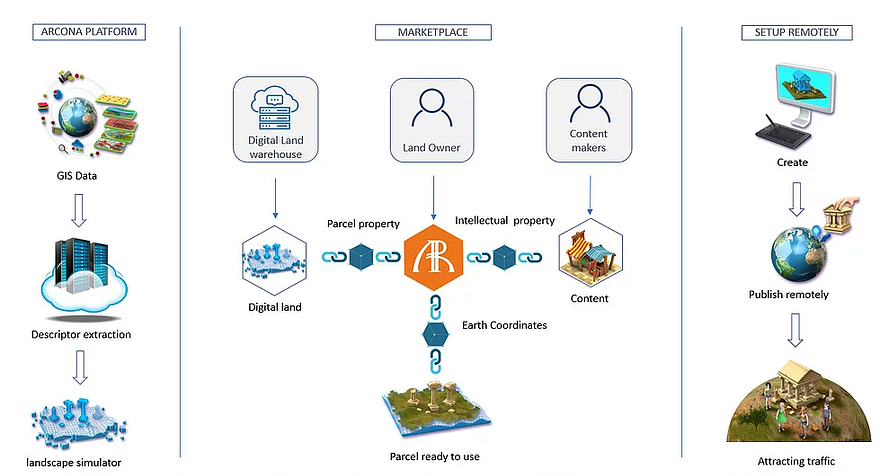
Arcona's digital land is a global augmented reality that can be generated automatically anywhere in the world. It's connected to a physically existing landscape, in which it remotely presents interactive content based on natural markers. That is, users will be able to create and demonstrate DR projects on other continents without having to leave home.
We asked the company representative of Piligrim XXI, created Arcona some questions about the prototype. The answers to them will be useful for developers who want to get to know the platform more closely.
What is a prototype, what can you do with it?
The project itself is a composition of ordinary systems of augmented reality, built on Unity machines, and automatic remote generation of markers. From a programmable point of view, the presence of this system differentiates the Arcona project with other DR projects.
As for the token generation system, it does not use machine and software environments that exist in enlarged reality areas, as they are functionally related to surface reconstruction areas, prototypes, point cloud generators, cloud point processing, polygonal recovery, and surface characterization. In this area, there are software solutions provided by standard OpenCV libraries (machine vision) and PCloud (working with point clouds). However, when implementing long-distance generator systems, there are a range of tasks that can not be satisfactorily resolved based on this library and other ready-made software solutions at this time. We solve such problems with the help of our own development, especially in the field of convolution neural networks.
Why did you publish the prototype?
Public access is caused by two reasons: 1) the solutions offered by the library are very attractive to those working in the field of prototypes, image analysis and related analysis; 2) Extensive testing will be very useful in further refining the library solutions used.
What is the next stage of development and when should it happen?
The first update has been issued, it will happen every 2-3 weeks. In general, we strictly adhere to the roadmap, described in the White Paper.
What developers need to start working with the platform?
Arcona Core is a statically connected C ++ library intended for use in versions of Microsoft Visual C ++ 2013 or higher. Libraries are assembled with all the required dependencies, so no additional procedures are required to use them. The current version only works on the x64 platform. The hardware system requirements depend on the size and complexity of the input data provided, but for the most part it's quite a platform with an Intel Core i5 processor and 4 gigabytes of RAM.
The Arcona Core Library presents solutions in the field of prototyping and computer vision, developed according to existing standards. Of course, they are not ideal for any purpose, but in some important tasks of the Arcona project, they work better than the ones offered by famous libraries like PCloud and OpenCV. The advantages of the method presented are given by using artificial neural network elements.
Aleksei Yemelyanov, head of the Arcona research team, in a separate conversation focuses on the differences between project decisions and their standards:
In recent years, the development of DR technological development methods has been carried out actively around the world. Thus, in the field of computer vision, quite acceptable solutions have been found for tasks such as the reconstruction of a three-dimensional surface of high-resolution GIS data and video stream circuits, the analysis of three-dimensional surface fragments based on reference database objects or individual object image evaluations. Many of them have become standard. And it poses a serious problem: new projects are built on templates, and therefore inherit their advantages and disadvantages. Unfortunately, recent advances in the field of computer vision, applied mathematics and neuroscience are often overlooked.
In our own research journey, alternative approaches are found that are more suitable for realizing the global augmented reality layer. In particular, analyzing a set of images using a recursive convolution neural network provides far more reliable results than solutions based on the use of differential operators through the discrete field of image pixels. The application of abstract tensor field analysis makes it possible to find unique solutions for geometric constructions and form modeling that significantly outweigh the analogs that exist in its properties.
Currently Arcona ICO and has managed to collect about 3 million dollars.
More interesting information about the project can be found here:
Official website: https://www.arcona.io/
Whitepaper: https://docs.google.com/document/d/1JbrIS5c-IDLbeiuOrycv2Fa91NG2xUkMabOWoevToRw/edit#heading=h.z2u036qtv13x
Official channels at social media:
Facebook: https://www.facebook.com/groups/arconaico/
Twitter: https://twitter.com/arconaico
Telegram: https: //https//t.me/arcona_ico
Reddit: https : //www.reddit.com/subreddits/search? q = arconaico
Medium: https://medium.com/@arcona
https://bitcointalk.org/index.php?action=profile;u=1771007


Komentar
Posting Komentar